Turn experience from work
into knowledge you can maintain.
Extract candidates from real work, review sources and conditions, accumulate and revise knowledge, then update the skills or prompts that reference it. Make knowledge useful for people and AI.
npm i -g oh-my-knowledge@nextNode.js ≥22 · Maintenance requires Beta.14 or later (@next). Check omk --version after installing; latest is the stable channel. Read the migration guide before upgrading
Observe. Measure. Know.
Start by reading. Keep maintaining.
Inspect existing records, then decide what to retain. Every revision has a reason; every artifact version links back to evidence.
Follow the workflow to your first stepRead records and sources
Start Studio and open an existing Codex conversation at the URL returned by the command. This makes no model call. If no records exist, start with source and collection guidance.
omk studioReview, accumulate, and revise
Choose a conversation and turns, review the material to send, then extract candidates. This calls a model and requires an authenticated runtime. Review conditions and evidence; retain or discard with reasons and explicitly link sources to accumulate knowledge.
Review references, then save a version
Artifact generation makes no additional model call. When knowledge changes, compare old references with current revisions and retain decisions. Explicitly select and save a new version; old content and references remain readable.
Revise old statements. Keep their history.
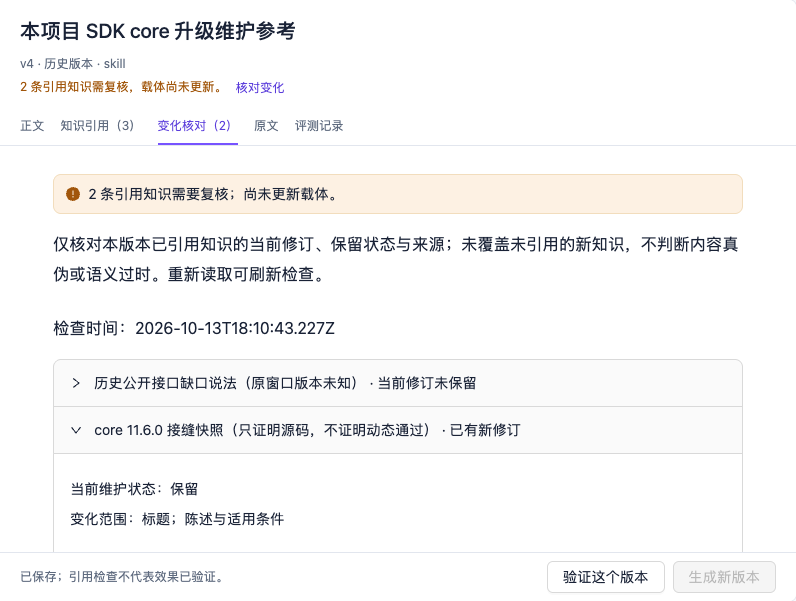
In the existing sentry-miniapp SDK case, correction requirements were limited to their historical context, one item was discarded, and another gained the condition “source presence, not dynamic test success.”
- v4
- Keeps three historical references and shows two review notices: a new revision or knowledge no longer retained.
- v5
- Explicitly selects two currently retained items: keep one, replace one, remove one. Historical v4 remains readable.
This is maintenance and reference evidence. It does not verify dynamic SDK effects, time saved, or cross-agent reuse benefits. No reference changes does not establish correctness.
Read the sources, changes, and review steps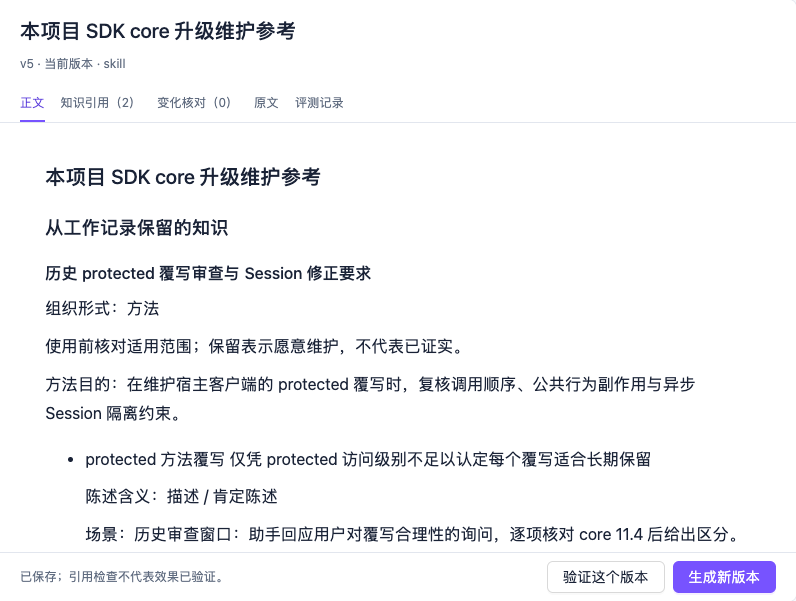
Have a specific task? Continue here.
Evaluation and service integration have independent entry points. Extraction is not a prerequisite.
Compare two knowledge artifacts
Preview the plan, configure a runtime, then call the model. Fix models and cases, record conditions, and inspect decisions and failures. The three starter cases only check the workflow; UNDERPOWERED is expected.
Preview your first comparisonEmbed in a Node.js service
Start with the offline Q&A example: run two sets of fixed answers and inspect case evidence and comparison results. The first example requires no model or model account. Connect your own service afterward.
Run the offline Node exampleAgent Skill · MCP · DSH · Tools and tasks
Review saving, use, and effects separately.
Retaining a candidate is a maintenance decision, not verification, and does not automatically rewrite AGENTS.md or skills. Compare under controlled conditions when you need task-effect evidence. Complete automatic cross-agent management and reuse remain in development; observation does not establish causality.
Explore all documentation